
The Teacher Talking Time Podcast

We CANNOT and DO NOT Control What Students Learn - Bill VanPatten
So many teachers focus on teaching when they should focus on something else. In this episode, we dive into this with the great Bill VanPatten. Bill VanPatten is an award-winning scholar and teacher with an international reputation in the fields of second language acquisition and second language teaching.
We chat with Bill about why:
the majority of teaching is not in accordance with SLA research
Krashen was right
Krashen's theories are not used in language education
teachers need to get rid of the "Atlas Complex"
most people don't understand what a communicative classroom means
grammar rules are not psychologically real
many researchers don't want to talk to teachers
understanding how non-college educated L1 speakers process language shows explicit instruction's ineffectiveness
if learners can do your assignments using AI, the assignment is flawed
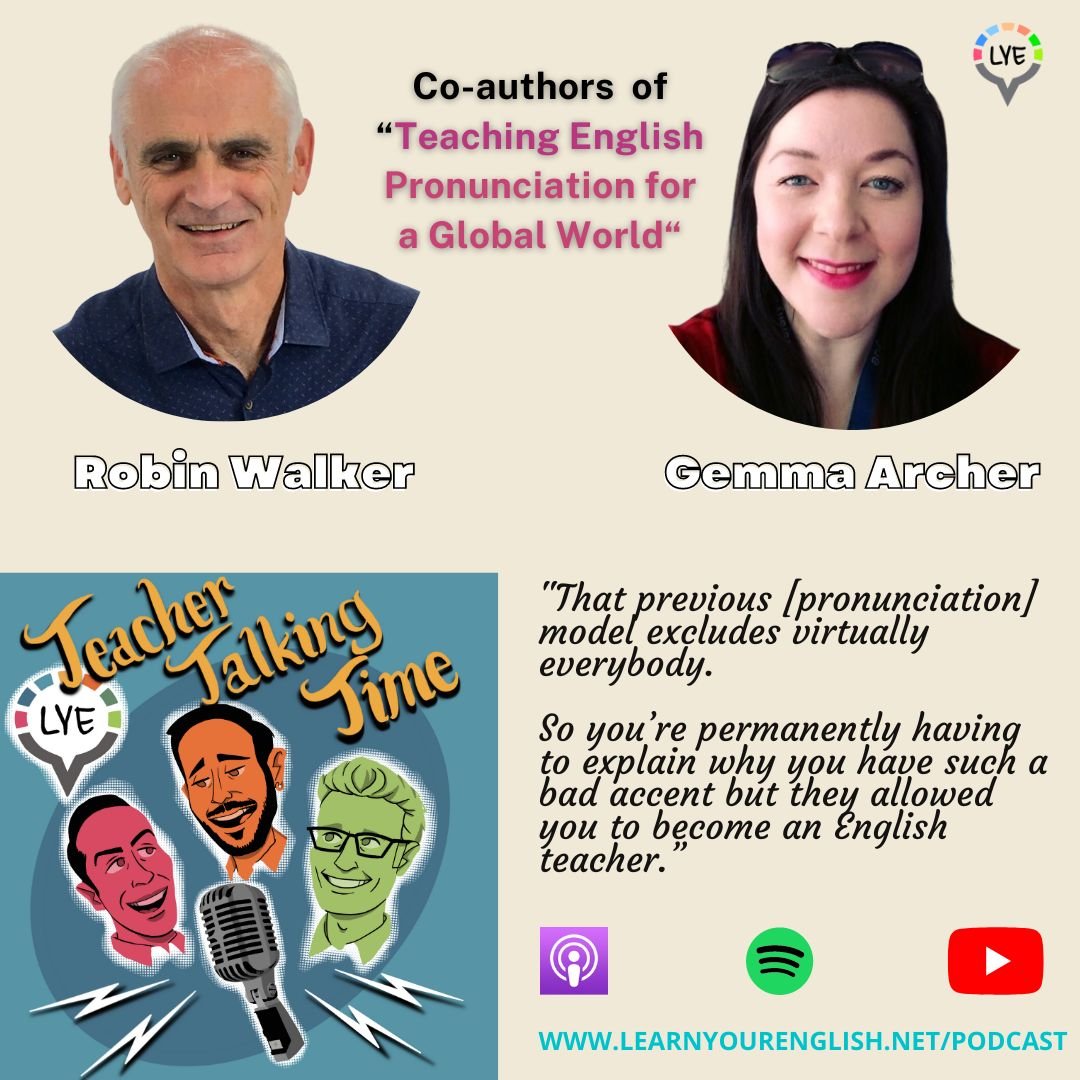
The traditional pronunciation model EXCLUDES virtually every teacher - Robin Walker & Gemma Archer
So many teachers feel they can't teach pronunciation if their speech doesn't sound a certain way. Listen to this episode to discover why that isn't true.
Robin Walker and Gemma Archer are pronunciation specialists who co-authored "Teaching English Pronunciation for a Global World," which aims to encourage pronunciation instruction from a lingua franca and intelligibility perspective.
We chat with Robin & Gemma about:
intelligibility, comprehensibility, and accentedness
why the Lingua Franca Core is what teachers should learn
their disdain for Jennifer Jenkins' criticism of them - before realizing she was right
how intelligibility is the thing that allows pronunciation to do its job
weak forms and why they're not necessary for intelligibility
why the goal of international intelligibility doesn't exclude other goals
how to measure intelligibility & use Linca Franca Core diagnostics with your students

TBLT isn't a fad & this is why NOT using it is holding you back - Lara Bryfonski
Lara Bryfonski is an applied linguist and assistant professor of linguistics at Georgetown University. She recently co-authored the book The Art and Science of Language Teaching with Alison Mackey.
In this episode, Lara dives into:
if "TBLT" is a fad
the myth that novice teachers can't handle TBLT
why experienced teachers are often the most resistant to try it
using a TBL approach within a strict syllabus
where grammar instruction fits into a TBL approach
what a task is and isn't
navigating a learner's internal syllabus
task design and how to apply it in your courses tomorrow
Twitch, gaming, and asynchronous TBLT
her advice for aspiring TBLT practitioners

Donna Brinton on Content-based Instruction (CBI)
Donna M. Brinton is a methodologist, trainer, author, and distinguished figure in applied linguistics. A key aspect of Donna's work is her advocacy for Content-Based Instruction (CBI).
In this conversation, Donna expounds on:
her beginnings as a teacher & her struggles with methodology
why she decided to focus on methods as a point of emphasis
content-based instruction and how it impacts language learning
developing and using a CBI syllabus
the 6 "t's" framework & the 3 CBI prototypes
CBI case studies around the world
the problem with minimal pairs and what can be done instead
the future of methodology & teacher development

2023 Wrapped: Making Next Year an Authentic One
Leo, Mike, and Andrew grab some nog, get in the holiday spirit, and chat about authenticity - Merriam-Webster's word of the year for 2023. We delve into what the word means to us and how we and anyone building a business can bring as much authenticity as possible into 2024.
Specifically, we dive into:
our process and struggles with niching down
why the response "teachers will love that" to our first offer was a bad answer
the "do one thing" philosophy to business growth
how you can develop sustainable practices in your business in 2024

Cecilia Nobre on Using Video for Teacher Development
Cecilia Nobre is a PhD candidate, teacher, trainer, and author. She has been an EFL teacher for over 20 years, and is a trainer on DipTESOL, CertTESOL, and Celta trainer. She recently co-authored the book "Using Video to Support Teacher Reflection and Development in ELT" with Steve Mann and Laura Baecher.
In this episode, Cecilia touches on:
video-based observation as a form of development
how videos can foster more critical reflection
using video recordings in both the physical and digital classroom
why every teacher should record their own lessons - and then watch them
how video observation can be incorporated into pre-service training courses
why video observation reduces the hierarchical relationship of traditional observation and how it can foster community building
advice for new educators just getting started

Geoff Jordan on ELT Now and How It Could Be
Geoff Jordan is a teacher, trainer, academic, and author. Geoff has a Ph.D. in Second Language Acquisition, has worked at ESADE, Barcelona for 28 years, and recently co-authored a book with the late Mike Long called "ELT Now and How It Could Be."His main academic interests are: theories of SLA, psycholinguistics, teaching practice and computational linguistics.
Specifically, Geoff touches on:
his beginnings in the ELT industry
working alongside Mike Long, Peter Skehan and Henry Widdowson in the early days
his new book "ELT Now and How It Could Be," co-written with the late Mike Long
how commercialization has hurt the language industry
why students should be angry after 300 hours of study when they still can't "go to the pub in London"
why task-based learning is the only way to go
why "presenting" language is inefficacious
how the future of the industry is in niche courses
advising students to be more resourceful in their learning
listener questions

Paul Nation on How Languages are Learned
Paul Nation is an Emeritus Professor of Applied Linguistics and renowned researcher and author in our industry. He joins us for a discussion on learning, putting research into practice, and - of course - the four strands 27 years later.
Paul touches specifically on:
his vocabulary niche
the birth of the four strands
how it's a basis for course construction, not lesson design
how he learned Greek on a 2 hour flight
why teachers who do extensive reading are brave
why teachers need to believe that by not teaching, people can learn
the only 3 things that matter in learning
if there is a fifth strand
Dogme Days of Summer
Andrew, Mike, and Leo sit down and ponder Dogme....as a new approach? It certainly has experienced a resurgence since the pandemic and we are curious why that is.
We also dive into:
the role of the teacher
the shift away from planning & towards reacting
what authentic communication actually means
how teachers can model lifelong learning habits
using Dogme in your business and using the less is more philosophy

Dylan Gates on Dogme and the RDS Method
Dylan was born just outside London and has been working in the ELT sector for nearly 25 years. About 12 years ago, he discovered Dogme, or as he prefers to call it “Teaching Unplugged.”
In this episode, he shines a light on:
how freelancing led him to Dogme
why he includes reactive teaching in his tool kit for the modern teacher
the RDS method for dealing with emergent language
key considerations for designing materials with a reactive mindset
the future of ELT, AI, and how teachers can innovate

Nicola Prentis on Investing in your Future Self
Nicola has been in ELT for over 20 years as a teacher, materials writer, and entrepreneur. Her interest in investing came about almost by accident when she began looking at her own woeful finances and she now supplements her income through investing and runs a course for beginner investors at The Chilled Investor.
In this episode, Nicola dives into:
how her childhood impacts her relationship with money
why many teachers sweep finances under the rug
what investing is and what it isn't
demystifying limiting beliefs about investing
why it's never too late
how "desperation is the mother of research, self study, and self improvement"
why precarity in our industry is more reason to invest in yourself, not less

Ken Lackman on the Lexical Approach
Ken has been in ELT since 1995. A teacher, trainer, and author, he has written or co-written over 20 books, including the recently published Connections 3 coursebook with Pearson.
In this episode, he dives into the lexical approach, why it never caught on and how teachers can use it in their teaching.
Specifically, we dive into:
how ELT has evolved
why Michael Lewis was "pissed"
Dogme ELT & its place
how teachers can decide which vocabulary to focus on in Dogme /TBLT
his CAT framework for Dogme
the post/no methodology era
students making "great mistakes"
the Lexical Approach
the future of ELT and AI

Teacherpreneur Challenges & Tackling Irrational Fears
Leo, Mike and Andrew return to the studio to discuss the most common challenges teacherpreneurs face. They get into the three hats that a teacherpreneur needs and how to build up each one.
Specifically, they talk about:
balancing the teacher, creator, and entrepreneur in you
teaching being the only profession where we feel guilty about earning more money
why a lack of goal clarity means you won't move forward
perfectionism as an irrational fear
niching and eliminating competition
creating equity in your business
a system to charge more
Lessons Learned in 2022
Leo, Mike, and Leo hop in the studio to record their annual year-end audit. Here, they reflect on the lessons they learned in 2022. They run through seven specific lessons that drive success, failure, and resilience.
Specifically, they discuss these concepts:
1. It always takes longer than you think it's going to take
2. Behind mountains are more mountains
3. Know what success looks like
4. Start small
5. Getting over the case of the "What ifs"

Danny Norrington-Davies & Richard Chinn on Emergent Language
Danny Norrington Davies and Richard Chinn have done extensive research on emergent language and have co-authored "Working with emergent language."
In this episode, Danny & Richard discuss:
the rise of emergent language
why many were resistant to the idea
the imbalance between research on error correction versus emergent language use
incidents that prevent language from emerging
the connections between emergent language and task-based learning
how teachers can develop their "emergent language muscle"
why the student's agenda supersedes the teacher's
how teachers can utilize emergent language even with beginners
why they decided to write a book on emergent language

Katarina Mentzelopoulos on Exceptionalism in Language Learning
Katarina Mentzelopoulos joins Leo and Andrew to talk about exceptionalism in language learning. She co-authored two books with the late Zoltán Dörnyei called “Stories from Exceptional Language Learners Who Have Achieved Nativelike Proficiency” and “Lessons from Exceptional Language Learners Who Have Achieved Nativelike Proficiency.”
In this episode, Katarina discusses:
what flow is and how it leads to language acquisition
how the theory of psychologist Mihaly Csikszentmihalyi has been adapted to language learning
characteristics of flow experiences
how tasks and TBLT are innate elements of flow
activities that are more conducive to creating flow
why flow and tasks are possible with all proficiency levels

Chris Jacobs on Flow Theory
Chris Jacobs joins Mike and Andrew to talk about flow theory. Flow is a state of deep focus on an enjoyable activity that is at once challenging and accessible.
In this episode, Chris dives into:
what flow is and how it leads to language acquisition
how the theory of psychologist Mihaly Csikszentmihalyi has been adapted to language learning
characteristics of flow experiences
how tasks and TBLT are innate elements of flow
activities that are more conducive to creating flow
why flow and tasks are possible with all proficiency levels
The Advantages of Disadvantages
Leo, Mike, and Andrew talk about burnout in education, Learn YOUR English beginnings, their journey, and how teachers can overcome obstacles.
Specifically, they discuss:
creating non-obvious solutions to obvious problems
how to follow the path of most resistance
why French impressionists decided to be big fish in a small pond
Ikea as an example of the five-factor psychological model of successful enterprises
delaying gratification as one of the most important tools for a teacherpreneur
how to exercise the idea muscle
why becoming the person you want to be means challenging the person you currently are

CEFR and the Dutch School System
This is a very special episode of Teacher Talking Time, in partnership with the University of Groningen in The Netherlands. This episode was created as part of an MA course "The CEFR in Context: Learning, Teaching, Assessment and Research" by Prof. Dr. Marije Michel and Dr. Audrey Rousse-Malpat. We at Learn YOUR English are thrilled to be a part of it coming to life.
Episode Description:
The CEFR is a useful tool for assessment and can be used to better align assessment across Europe. But is this what is actually happening? In this podcast episode, assessment and the CEFR in the Dutch school system will be discussed from the perspectives of experts in the field of research, secondary school teachers of English, and students studying to become teachers of English

Anthony Gaughan
Anthony Gaughan is a teacher and teacher-trainer with over 25 years of experience. Together with his then-colleague, Izzy Orde, Anthony first applied Dogme ELT principles to running CELTA courses in 2009, and has been advocating for simplifying initial teacher education ever since.
In this episode, Anthony dives into:
how a Japanese balloon pushed him towards Dogme
teaching versus teaching-like behaviours
transforming CELTA training into unprescribed, dogmatic experiences
why he was called irresponsible and dangerous at IATEFL
training as a suspension of disbelief
debunking myths about beginner students, beginner teachers, and new beginnings
Subscribe to the Show
Teaching Talking Time is an English Language podcast aimed at teaching professionals and learners. Leo, Mike, and Andrew bring you discussions, interviews, and debates on English language training and learning. From approaches, misconceptions, and successful and failed case studies, each episode is dedicated to their vision: continual growth. They interview teachers and learners from around the world, and also debate the merits of common teaching approaches.
We release two episodes a month: one for teachers and one for students.